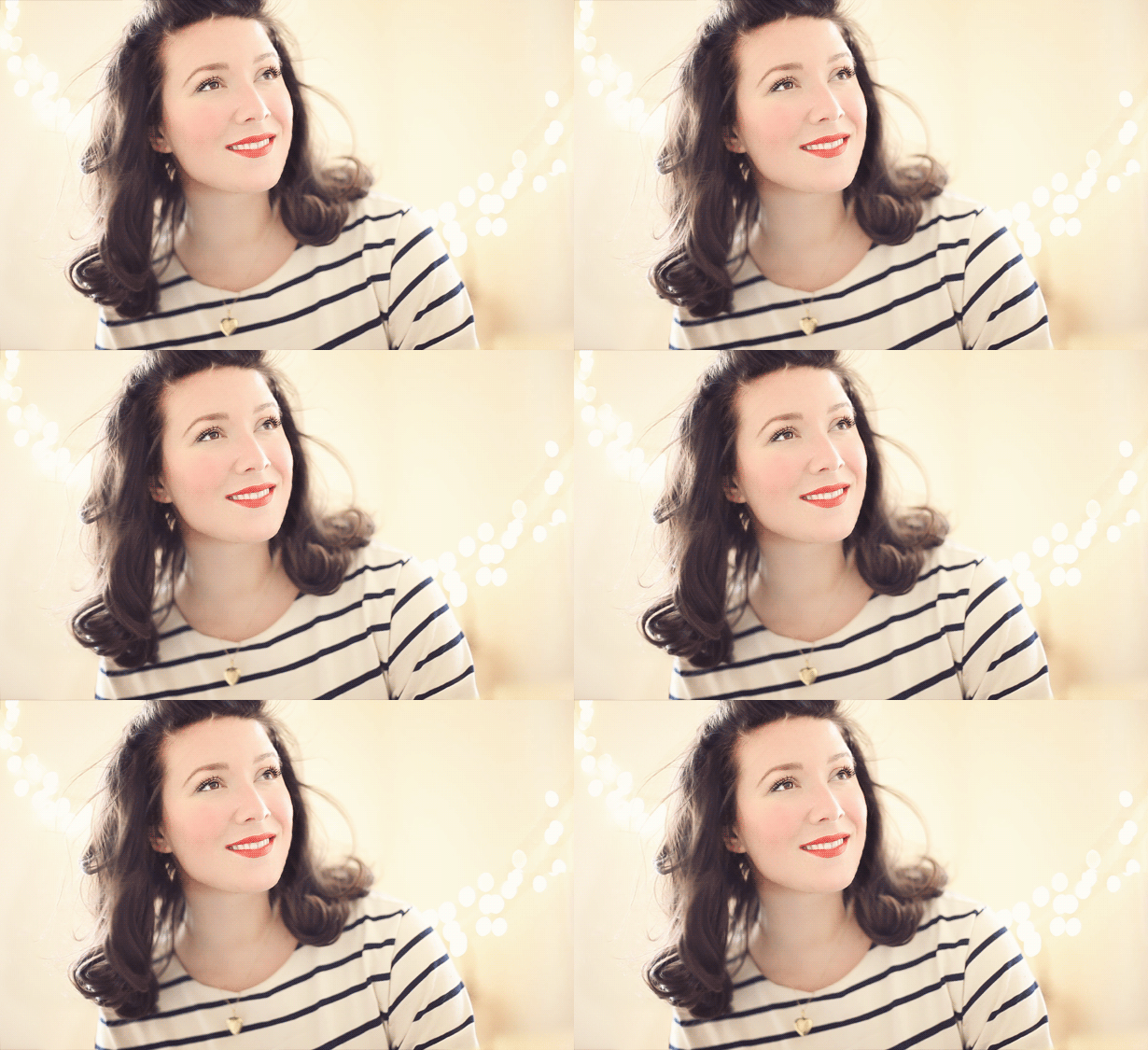
Daniel Shea, makes us happy.
Our Weekly, biweekly, interview series continues with our interview with East Coast “Dreamboat Photographer” Daniel Shea.
Daniel is a 2007 Grad, who has currently been doing work with a subject matter that we find fascinating. Earth; and our impacts on it.
© Daniel Shea
Daniel offers a interesting perspective as well on his blog. Wish him luck in the future, Please take the time to check out his work, in all its glory.
Q1. We see you are a recent graduate and on your website it states you are a K-12 Arts Teacher. Do you plan on grad school? Why not tell us more about yourself for the people who don’t know?
I graduated from art school a year ago, although it feels a lot longer than that. I've worked 8 jobs since, on top of being a freelance photographer, so it's been a hectic year. From August through October of 2007 I went to the Appalachian region to make Removing Mountains, and when I came home to Baltimore I eventually found myself substitute teaching at an amazing arts-based school for students with learning disabilities. A position opened up for a full-time art teacher, and seeing that the school is a private institution, I didn't need a Masters in Education to teach, so I jumped at the opportunity. It's been one of the most rewarding jobs I've ever had. As I type this up my 12th grade Portfolio Class and I are in the media center exploring the PBS Art 21 site. The potential for me to expose students to a variety of artists, both traditional and non, is amazing.
That's my current situation, the rest of my life isn't really that interesting or unique. Basically I grew up in DC and Chicago, tried way too hard to fit in as a kid, gave up on that, was socially awkward in high school, discovered hardcore punk, radical politics, and good art/photography, and left boring civilian life happily behind, never to look back.
© Daniel Shea
Q2. Your work positively seems to be all over the place. We see portraits, landscapes, editorial, emotional, and conceptual ideas as themes throughout your work; have you had any negative feedback regarding the spread of work we see?
The most formative artists and photographers for me in college consisted of a variety of conceptualists (for lack of a better term) who made work using the medium that was most fitting for their explorations, as opposed to sticking to a medium and subsequently making work that indirectly embraces its inherent constraints. So for me, when I started to make work that was even remotely successful, about half way through college, photography became very much about photography . However, I've somewhat reluctantly acknowledged my primal love for photography, and, to put it tritely, the pure joy in composing and making a photograph through a camera and lens. This can at times present a working predicament, however inflated that may sound.
But yes, essentially I make the type of image/series that is most conceptually consistent with my idea and subject matter. My current work, which is relatively traditional in many ways, "straight photography," if you will, is built upon a rigorous examination into the historical delineation of landscape, both in painting and art. I brought that knowledge and interest to Removing Mountains. Some of my earlier projects in college were straight social documentaries addressing some politicized issues that I was fired up about. My new work really coalesces the two; the historic significance/power of the social document, built on a strong understanding of the historic motifs that are, by default, referred to in the images.
With all that said, I'm not necessarily interested in anyone knowing that. It ends up convoluting the main intention of the work, which is to look and respond emotionally, politically, and artistically. I write all this to sort of explain my working process.
I think that answers your question in a tangential way. In terms of negative feedback, the best I've received really questions the more ethical issues that are inherent to being a privileged outsider photographing what can be interpreted as marginalized people. However, I try to play the agency card, and photograph in a way that allows the subject to take control of that space between viewer and interpretation. I basically try to uphold any and all integrity that exists on the stage the subject is being photographed on.
© Daniel Shea
Q3. The focus we really see is of your interpretations of land use in and about coal mining. Are you familiar with the Center for land use Interpretation? What is your ultimate goal with this work?
It's interesting that you bring up CLUI, a group that really represents a new interest in extending public discourses in multidisciplinary manners, which I think is a very, very important thing to do today. CLUI functions in several ways, all very subversive, considering their image and pragmatic phrasing, which is awesome.
The ultimate goal is for people to see this work, in book form (which is how I've envisioned it all along), in galleries and non-traditional physical art viewing spaces, and on the internet. All the stuff that happens in that process I'll answer in the next question...
© Daniel Shea
Q4. Can you explain your concept “to build a narrative out of context...and then more context. After all, I consider this body of work to be art about a political issue, not political art. By default, many associations will be immediately made, but my hopes are that the viewer will eventually look at the group of photographs as a complex series of potential contingencies, much like the issue being dealt with.” This seems like a pretty big task to take on photographically, do you plan on writing about and or doing any motion documentary work within this concept?
I guess in a way it comes down to the question, "Is (your) art political?" which is a question worth asking, and often not worth answering, due to its seemingly rhetorical nature. I have very strong feelings about what's happening in Appalachia because of coal mining, but it's important that I keep that to myself while on the road, and often when talking to other people (I'm really bad at the second part). In the end I absolutely want people to walk away from an exhibit thinking about American power dynamics in this day and age. My intent is for the dialogue to be initiated by the images, not handed out as a mission statement, which is where I'm going with the quote in the question. From the viewer response of my first exhibit, I think people are really thinking about the issues, and going home and researching mountaintop removal and coal history, which is great. Deep down, this is what I really want more than anything, people to think, but I still want to make art that isn't politically in your face. Subtlety and context are probably the words I use most in artspeak.
I've written extensively about this issue, and I'll have a significant amount of writing in the book I'm working on. I don't see myself working with video/film any time soon, but who knows. I'm mostly obsessed with photography. The medium of photography itself is historically crucial for this type of work, and the way people respond.
© Daniel Shea
Q5. How do you go about gaining access to the mines you have photographed? Are they interested in your overall concept? Or are they protective?
When I was on the road, I was still trying to figure out what I was doing. I toned down my ideas a lot when talking to people, not because I didn't think people would understand, but for practical reasons. The access I gained was because I was a "non-biased social documentary photographer." I told people very bluntly that I was just interested in looking. I gained access to the mine sites by frequently tagging along with one organization's outings, which led me to encounter West Virginia's Department of Environmental Protection (DEP) agents. One man in particular (the guy with the outstretched hand standing on the mountaintop removal site in one of the photographs) really wanted to show me the whole operation start to finish. The day we went and did this, I couldn't help but feel he was trying to demonstrate sheer power and advanced technology. For him, this was the American legacy and thus justified. I agreed with him on the former. That was one of the most intense days of my life, to witness energy extraction in it's unfiltered essence. It's something we all take for granted, and I still do to this day.
Protective doesn't even begin to describe the level of secrecy that surrounds some of these mine sites. Before getting "official" access with the DEP, I spent a lot of days hiking mountains and trespassing, something I wouldn't recommend. I gained invaluable advice from talking to countless locals who grew up in the mountains and knew them front and back. The action of me trespassing was maybe an ethical point of conflict in retrospect, not because I give a shit about corporate interests, but the presumption that a city kid can come in and do what people have done all their lives, carefully and skillfully, isn't a good attitude to have and purport. I didn't have this attitude at all. I was always very respectfully, but I was very conscious of these dynamics, and did my best to stay within my boundaries as an outsider.
© Daniel Shea
Q6. What have you learned from the comments about your work on Flickr? Do you find the commenting system on Flickr as a positive or a negative? Does a system like this help you as a professional?
Flickr is some serious business! Flickr is what it is. I have absolutely nothing to add to the argument for or against it. I use it because I'm anxious and love uploading work as soon as I scan it. I guess that makes me a child of modern convenience. I've honestly made a lot of amazing contacts/friends on flickr, and subsequently have been exposed to a lot of good work. As for comments, I don't really like them, but, flickr isn't supposed to be taken seriously. I'm worried about Yahoo having unconditional rights to images, something I'm fundamentally against, but at the end of the day I care more about other things than to dwell on flickr politics. I sound like a jaded asshole sometimes, I'm well aware.
© Daniel Shea
Q7. With our acerbic take on youth and photography, what would you like to interject regarding the future photography? Do you see an influx of technology and Internet connections as a positive? Where do you see the future of this influx going?
Your acerbic attitude is welcome, trust me, I'm sure I speak for all those outside the circle-jerk internet photo/blog world (and if I don't, sorry). I have strong opinions, but one thing I've never been into is predicting the future and direction of art. Plus, we all see the trends. No need to regurgitate them here. I will say that the internet, in its incarnation 2.0, has a profound impact on the medium, if not shaping a new medium of photography that perhaps should be aptly named something clever. Hopefully a majority of this contax-inspired, soapy-boobage, self-love myopic horse shit will bury itself in google archives in 10 years, but a trend is a trend for a reason. I love the internet, but not as much as books and prints.
© Daniel Shea
Q8. You are the first photographer that we have ever seen a comment on a website that states “...this website is most definitely not copyrighted. however i do retain some rights, theoretically. if you are ethically confused about what to do with an image of mine that you may or may not want to use, read here. or contact me.” What do you think about the role of new photographers and the ideas of ownership?
Ownership is a sedation tool for the masses, among many, many other things the smart capitalist swine come up with. Really though, props to them, they've really got us fighting over the stupidest shit. I'm being semi-rhetorical with what you quoted, I could have just said "don't be an asshole," and have said the exact same thing. I don't have any illusions of grandeur, and I'm not trying to be revolutionary, I just don't believe in copyrighting, at least ideologically. In terms of art discourse development in the last century, it seems a bit reactionary to get hot and sweaty over the fine print (unless it's a c-print, cha ching!). I understand the importance of having the rights to your image, I just chose to distance myself from the politics. Basically I stand behind creative commons.
Q9. Whats the deal with all the cool people living in Baltimore?
It's a fucking cool place, simply put. The resources and conventional institutions that exist in more established art scenes don't exist here. So by default, the art scene is run by the artists, which is how it should be everywhere, in my humble opinion. In Baltimore people build what they want from scratch. DIY still means something, which is rare. I love Baltimore, but after a dutiful 5 years, I'm moving to Chicago in the Fall, where I spent my high school years, to eventually go to grad school and yell in hardcore bands.
Q10. According to a comment on your blog, you are a photo dreamboat.
What do you have to say about this?
Q11. Whats next for Daniel Shea?
I'm working on a couple of new projects, particularly a long-term multi-faceted take on Baltimore. This project will hopefully serve as a polemic, but I have to be careful with what I'm planning. I'm also going to start applying for grants to do an extension of the mountaintop removal work, in the Ohio River Valley, where coal is being burned. I have a project that I'm really pumped on, that I plan on executing in about 3 years, but I'm keeping it a secret, because secrets are fun, and I don't want anyone else to do it (speaking of ownership). Also, Removing Mountains will be published as a book in early 2009, but I'm not releasing the press name yet, and trying to keep it on the down low.
Q12. Any questions we forgot to ask?
Don't you want to know what glass I'm using??
-------------------------------------------------------------------
Thank you Daniel.
Keep up the good work, we look forward to seeing it.
As for us at F.O.T.
Next week we promise to start another argument, dialog, banter, etc etc.
But first, anyone know how we can get ahold of this dude?
Rather then us “cold emailing him” because he is one busy guy.
We want to interview him next.
Get ready to comment, because we really want to have some dialog.
I we don't care if it is good bad or ugly.
Plus, we are going to be taking about this topic
if you made this comment
“Yes, can we have a post on trying to get into the art world without an MFA and said program getting you your first shows?
I've been to MOCA, LACMA, MOMA, SFMOMA, the Prado, Reina Sofia, and Thyssen over ten times each and to the Lourve and Tate twice. I've gone religiously to gallery shows ever month wherever I've lived to see virtually everything showing in the contemporary market. I shoot daily and have poured over countless hours on the internet to educate myself.
But I guess I'm just not as well prepared or legit as these kids.”
we would like to talk.
contact us!
fartingonthunder (at) gmail.com
we asked about,
and need to respond appropriately.
please do email us with any questions comments or
work you want us to give our 8.5 cents about.